
Key Takeaways
- Measuring knowledge management ROI helps you connect knowledge initiatives to real business outcomes instead of relying on assumptions.
- Improvements in productivity, support efficiency, onboarding, and customer service all contribute to measurable returns.
- Tracking the right operational metrics makes it much easier to calculate financial impact over time.
- A structured approach helps demonstrate knowledge management business value to leadership and secure future investment.
Most organizations believe knowledge management creates value, but proving that value is often much harder.
Unlike a new piece of equipment or a software license with obvious cost savings, knowledge management affects many parts of a business at the same time. Better documentation can improve employee productivity, reduce customer support costs, shorten onboarding, and improve decision making. Because those improvements happen across multiple departments, they aren't always easy to measure.
This challenge causes many teams to stop tracking results altogether.
Instead of measuring outcomes, they focus on activity. They count articles created, documents uploaded, or pages viewed without connecting those numbers to business performance.
Several factors make measuring knowledge management ROI difficult:
- Benefits often appear across multiple departments.
- Improvements happen gradually rather than all at once.
- Some gains, such as employee confidence, are difficult to assign a dollar value.
- Organizations may not establish baseline measurements before implementing a knowledge platform.
Rising Dependance on AI
Despite these challenges, measuring results is becoming more important. According to Microsoft's 2025 Work Trend Index, employees increasingly depend on AI and digital tools to manage growing information demands. As organizations generate more content, leadership expects stronger evidence that knowledge investments improve productivity and business performance.
Understanding the benefits of implementing knowledge management makes it easier to identify where measurable improvements should occur.
The goal isn't to calculate every possible benefit. Instead, focus on the outcomes that have the greatest impact on your organization.
The Business Outcomes Knowledge Management Actually Affects
One reason measuring the ROI of knowledge management feels difficult is that knowledge influences many everyday business activities.
When employees spend less time searching for answers, customers receive faster service, new hires become productive sooner, and experienced employees can focus on higher value work. Each of these improvements creates measurable financial value.
Below are several of the most common business outcomes that organizations track.
Average Handle Time
Customer support teams often measure Average Handle Time, or AHT, to understand how efficiently agents resolve customer issues.
When agents can quickly locate accurate information, conversations become more efficient without sacrificing quality.
Potential improvements include:
- Faster access to approved answers
- Less time searching multiple systems
- More consistent responses
- Higher first contact resolution
Reducing handle time across thousands of customer interactions can create significant cost savings over the course of a year.
Employee Onboarding
Training new employees takes time and resources.
A well organized knowledge platform allows new hires to find answers independently instead of relying entirely on experienced coworkers. This often shortens onboarding while helping employees become productive more quickly.
One of the most powerful benefits of enterprise knowledge management is faster onboarding which can become a valuable long term advantage.
Error Rates
Outdated documentation and inconsistent processes often lead to unnecessary mistakes.
When employees have access to current, trusted information, they make better decisions and follow approved procedures more consistently.
Lower error rates can lead to:
- Fewer compliance issues
- Reduced rework
- Higher service quality
- Better customer experiences
Although error reduction may seem difficult to measure, many organizations already track quality assurance scores, process compliance, and customer satisfaction. These metrics can help demonstrate knowledge management business value over time.
Escalation Volume
Escalations increase costs because they require additional employee time and management involvement.
Strong knowledge resources help frontline employees solve more issues independently, reducing the need to involve supervisors or specialized teams.
Lower escalation rates often improve operational efficiency while creating a better customer experience.
Agent Turnover
High employee turnover creates significant costs through recruiting, hiring, and training.
Knowledge systems help reduce frustration by making information easier to locate and daily work more manageable. Employees who feel supported often become productive more quickly and spend less time searching for answers.
While turnover depends on many factors, effective knowledge management can contribute to a better employee experience.
Why These Metrics Matter Together
Looking at only one metric rarely tells the full story.
A small improvement in average handle time may seem modest by itself. Combined with faster onboarding, fewer escalations, lower error rates, and improved employee productivity, however, the overall financial impact becomes much more meaningful.
That is why successful organizations evaluate several operational measurements together instead of relying on a single performance indicator.
Building a strong knowledge program begins with identifying the business outcomes that matter most, measuring current performance, and tracking improvements over time. Establishing clear baseline metrics makes it much easier to perform an accurate knowledge management ROI calculation and demonstrate the long term value of your investment.
How To Calculate Knowledge Management ROI
Once you've identified the business outcomes affected by knowledge management, the next step is assigning financial value to those improvements.
Many organizations make the mistake of trying to calculate knowledge management ROI using only software costs. While implementation expenses certainly matter, the largest return usually comes from operational improvements that continue year after year.
A practical knowledge management ROI calculation typically includes four steps.
Step 1: Identify Your Investment
Start by calculating the total cost of your knowledge management initiative.
This may include:
- Software licensing
- Implementation services
- Employee training
- Content creation
- System administration
Knowing your total investment provides the baseline for every future calculation.
Step 2: Measure Operational Improvements
Next, identify where measurable improvements have occurred.
Common examples include:
- Lower Average Handle Time
- Faster onboarding
- Fewer escalations
- Reduced error rates
- Higher employee productivity
- Better first contact resolution
These operational improvements often create the largest financial return because they occur every day across the organization.
Step 3: Assign Financial Value
Once improvements are measured, convert them into estimated financial savings.
For example:
- Saving two minutes on every customer interaction can translate into hundreds of employee hours each month.
- Reducing onboarding by one week allows new employees to become productive sooner.
- Lower error rates reduce rework and quality costs.
- Fewer escalations allow supervisors to spend more time on higher value work.
Even conservative estimates can demonstrate significant knowledge management business value when improvements are measured across an entire year.
Step 4: Calculate ROI
After estimating annual savings, compare those savings to your total investment.
A standard formula is:
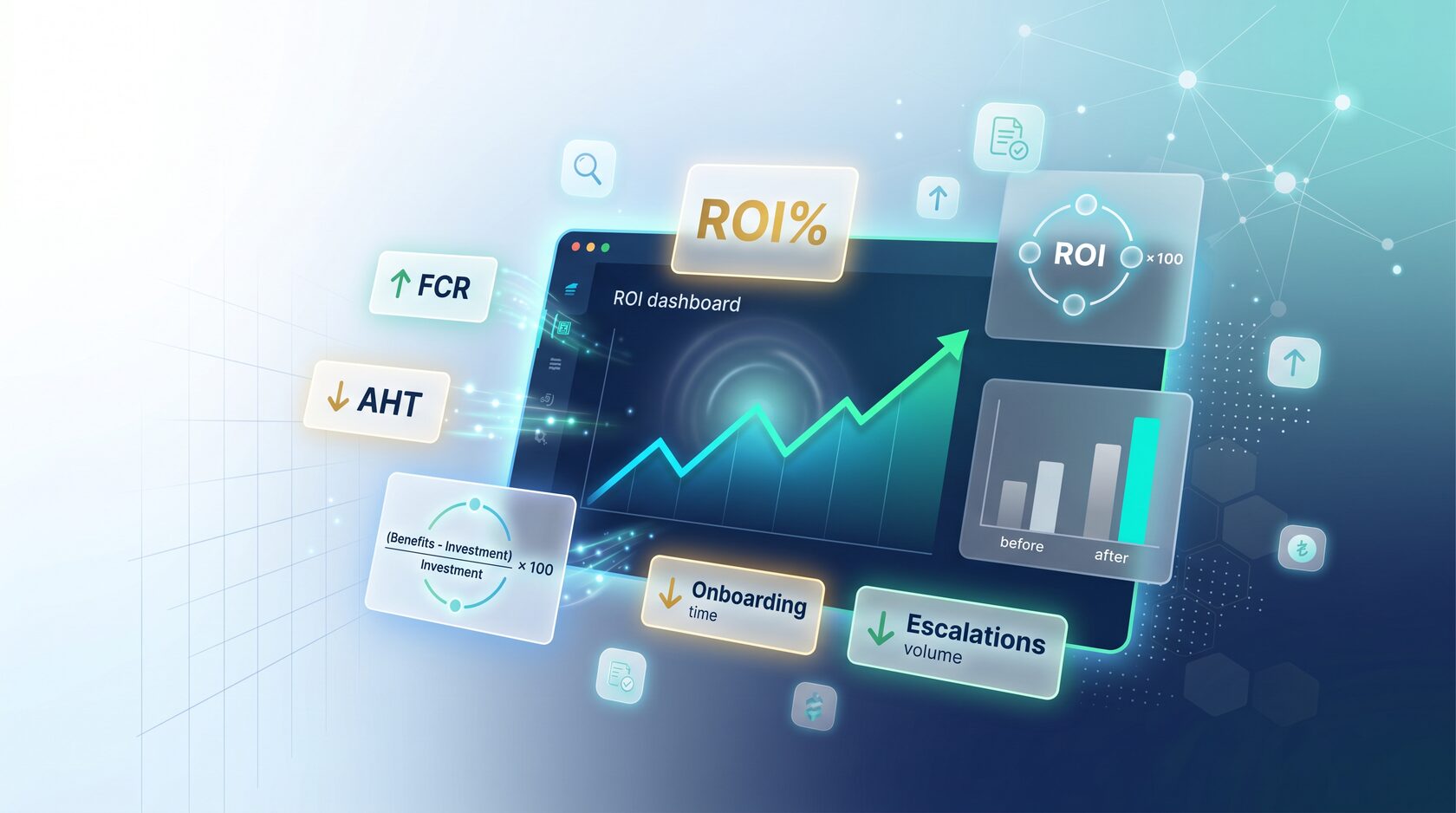
ROI = (Annual Benefits − Total Investment) ÷ Total Investment × 100
While every organization is different, using the same calculation method each year makes it easier to demonstrate long term trends and support future investment decisions.
The Metrics That Serve As Leading Indicators Of ROI
Financial results rarely appear overnight.
Before organizations see measurable returns, several operational metrics usually begin improving first. These leading indicators provide early evidence that your knowledge program is moving in the right direction.
Content Usage
High quality knowledge only creates value if employees actually use it.
Tracking article views, repeat usage, and popular topics helps identify which content provides the greatest business impact.
Search Success Rate
Search performance is one of the strongest indicators of knowledge effectiveness.
When employees consistently find the right information on their first search, productivity often improves while frustration decreases.
Time To Answer
Whether supporting customers or internal employees, faster access to trusted information usually reduces response times.
Monitoring average time to answer helps demonstrate the operational impact of better knowledge.
Knowledge Adoption
Successful knowledge programs become part of employees' daily workflow.
Useful adoption metrics include:
- Daily active users
- Search frequency
- Article usage
- Knowledge contributions
- Repeat visits
Organizations tracking customer service analytics often discover that these operational measurements improve well before financial ROI becomes obvious.
How To Build The Business Case For Knowledge Management Investment
Leadership teams rarely approve investments based on assumptions alone.
Decision makers typically want evidence that a knowledge initiative will improve efficiency, reduce costs, or support strategic goals.
Instead of focusing only on software features, connect knowledge management to measurable business outcomes.
For example, show how improvements in onboarding, search efficiency, customer support, or productivity affect financial performance.
Executive stakeholders often care most about:
- Cost reduction
- Productivity gains
- Customer experience
- Employee efficiency
- Risk reduction
- Long term scalability
Presenting knowledge management ROI alongside operational improvements creates a stronger business case than discussing technology alone.
Accurate reporting and analytics play an important role when evaluating knowledge management software in contact centers because they make it much easier to measure performance, identify trends, and demonstrate ongoing value.
How KMS Lighthouse Supports ROI Tracking Through Built In Analytics
Measuring ROI becomes much easier when your platform provides meaningful analytics.
KMS Lighthouse helps organizations understand how knowledge is being used by providing visibility into search activity, article usage, content performance, and employee engagement.
Instead of relying on assumptions, organizations can monitor measurable indicators that support long term improvement.
Examples include:
- Search behavior
- Content usage trends
- Knowledge gaps
- Article effectiveness
- User adoption
These insights help organizations improve content quality while making knowledge management ROI easier to measure over time.
Recent research continues to highlight the importance of measuring business performance. According to Microsoft, organizations increasingly rely on AI and data driven insights to improve productivity and decision making. Measuring knowledge performance is becoming an increasingly important part of that effort.
FAQ
Many organizations begin seeing operational improvements within the first few months after implementation. Measurable financial ROI often takes longer because trends such as productivity, onboarding efficiency, and customer service performance require consistent tracking over time.
ROI varies based on support volume, adoption, and business goals. Organizations that reduce handle time, improve first contact resolution, and shorten onboarding often experience meaningful financial returns that continue growing as knowledge adoption increases.
Start by measuring current performance, including search time, escalations, onboarding length, error rates, and employee productivity. These baseline measurements make it easier to compare results after implementation and calculate improvements accurately.
Both approaches work. Many organizations begin by measuring ROI within customer support, IT, or HR before expanding to the entire organization. Department level measurements often provide faster insights while supporting larger business cases later.
Knowledge management ROI focuses on measurable financial returns compared to investment costs. Knowledge management value includes broader benefits such as improved collaboration, stronger decision making, better employee experiences, and increased organizational knowledge that may be more difficult to express in financial terms.
Why Measuring ROI Strengthens Every Knowledge Program
Measuring results helps transform knowledge management from a support function into a strategic business investment. When organizations connect operational improvements to financial outcomes, it becomes much easier to demonstrate long term value, prioritize future improvements, and build confidence in continued knowledge management initiatives.
Contact us today to learn how KMS Lighthouse can help you measure, improve, and maximize the return on your knowledge management investment.


