The enterprise-specific information your organization has and needs is an asset. It’s valuable knowledge. And the quantity of knowledge rapidly increases every day. It must be consistent and available throughout your organization and at the same time, outdated analytics need to be archived, edited, or removed.
Knowledge management (KM) is the process of:
- Creating and/or
- Identifying
- Organizing
- Storing and
- Sharing
…information for utilization by your company.
The sheer volume of information you never thought you would need to handle is why AI-driven knowledge management is critical. Understanding the phases of the knowledge management life cycle helps you maximize the value of this organizational and sales asset.
What Is the Knowledge Management Cycle?
Knowledge management content examples are:
- Data warehouses – Storage for data analyses from different sources
- Document management – Centralized storage for digital documents, images, & other files
- Intranets – Private networks, company directories, etc.
- Web management – Content editing/publication, including audio/video
- Wikis – Easily accessed, east-to-use information storage
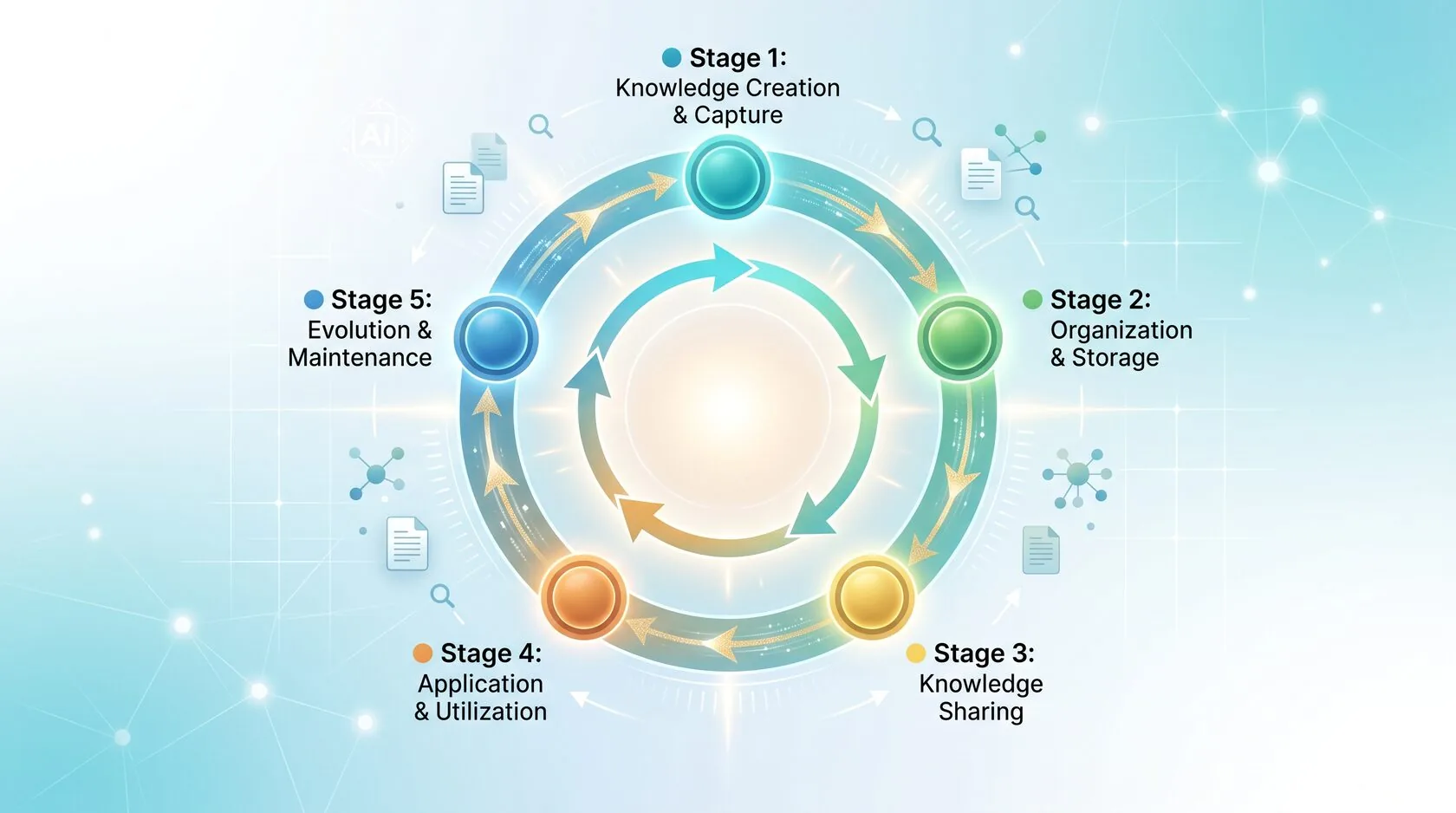
The knowledge management cycle is the process by which your KM hub gathers, analyzes, shares, and applies information content. Generative AI takes the methodology to another level by creating knowledge.
Just as you have a system of best practices to manage a constantly evolving business environment, you need a knowledge management process to filter information. You don’t want to clutter the knowledge base with useless data, but you can’t risk missing important information. The knowledge management cycle maximizes the usefulness of an information base by unifying fragmented and sometimes confusing content. This makes it more easily accessible and actionable by employees.
Benefits of KM Cycle Implementation
A knowledge management cycle doesn’t occur without a team of facilitators: knowledge managers, IT professionals, change agents, content owners/editors, and others. The timeline has many variables (available automation tools, company size, team collaboration culture), etc.), but the main factor is the type of KM cycle you’re planning:
- Strategic – Strategic KM cycles could take weeks or months. It can include:
- Auditing information silos
- Mapping search pathways
- Technical restructuring
- Tactical – A tactical KM cycle is a day-to-day procedure that can take an hour or all day. Teams will focus on:
- Accuracy checks
- Creating SOPs, FAQs, and/or wiki FYIs
- Logging (support tickets, for example)
- Problem-solving
- Updating content
The value-add is priceless:
- Better employee/team collaboration
- Confident decision-making
- Consistent customer service delivery
- Continuous education
- Easier, faster employee onboarding
- Empowered customer self-service
- Error reductions
- Faster support ticket resolution
- Improved efficiency
- More first-contact customer support resolutions
- …and more
The 5 Stages of the Knowledge Management Cycle and What to Do at Each
You’ll see knowledge management stages described as 5, 6, or even 7 processes, but the KM cycle always begins with identifying or creating, then capturing information.
Stage 1: Knowledge Creation and Capture
The knowledge management cycle begins by capturing data from interior and exterior sources, as well as creating information (from documents, employees, and support tickets, for example). This content must be audited/validated for accuracy and standardized for across-the-enterprise usage.
What Now?
Identify subject matter experts (SMEs) to learn what unwritten, unshared processes exist. Collect fragmented knowledge and high-value content, centralize it, and migrate it to your KM base.
- Appoint SME teams to review, update, and ensure ongoing procedures.
- Ask employees what issues arise most frequently.
- Ask teams which problems take longer to resolve.
- Following every project, quickly document decisions made, lessons learned, and procedures used.
- What knowledge do employees have now that they wish they’d learned as new hires?
The Stage 1 outcome should be new and true content that includes written processes, articles, and documentation.
Stage 2: Knowledge Organization and Storage
Standardize knowledge with templates when possible. AI helps develop a clearer foundation using logical structuring, and this makes knowledge more easily searchable and understandable by employees, agents, and – if applicable – customers.
What Now?
Authors should use consistent, common tags and keywords. Enable robust searches by mandating metadata tagging by contributors.
- Articles should have obvious, searchable titles.
- Define content standards by creating style guidelines, including fields for “date created” and “date revised.”
- Implement permissions and access controls as well as a revision process. Internal SOPs, etc., should not be accessible by customers, for example.
- Link related knowledge.
- Tag content with keywords.
The Stage 2 outcome should be standardized, logically named, & categorized content knowledge that is easily navigable and effortlessly searched.
Stage 3: Knowledge Sharing
Knowledge sharing is the most dynamic phase in the KM cycle. Individual information and experience can now be dispersed throughout the company. This encourages collaboration between teams as critical knowledge is retained and improved upon.
What Now?
- Documented assets can include Wiki, FAQs, etc.
- Individual expertise is now collective, organizational intelligence.
- The KMS platform is maximized as a collaborative tool, integrating with social or dedicated apps (Slack, etc.).
- The right information is easily accessible to the right people.
The Stage 3 outcome is information ownership, generative ideas, and valuable employee experiences are now disseminated across the organization.
Stage 4: Knowledge Application and Utilization
Enterprise knowledge is only good when employees use it. The goal of Stage 4 is to encourage knowledge utilization by integrating it into employee workflows, decision-making, and support ticket resolutions.
What Now?
Stage 4 helps define ways employees use the knowledge base:
- Flowcharts, decision trees, and how-tos are created & organized for employee guidance.
- Reminders can be included at the end of process guides to verify employees understood and retained the information.
- Train new hires and employees unfamiliar with the knowledge base.
The Stage 4 outcome is employees understand and are invested in applying knowledge base content to problem-solving and decision-making. Productivity and first-contact resolutions (FCRs) increase.
Stage 5: Knowledge Evolution/Maintenance
Your knowledge base is an ongoing project. Technology changes rapidly, and processes evolve as users refine them. Customer care priorities shift as customers’ needs change.
Regularly review information for accuracy. Evaluate workarounds; can system upgrades include automated fixes? Knowledge management eliminates outdated, unnecessary data and seeks improvements. KM stays current.
What now?
Knowledge is generated and updated daily, as your agents and customers manage their accounts and resolve issues. The KM cycle is circular; stage 5 loops back to stage 1, as knowledge is utilized and support ticket escalations decrease.
- Evaluate support ticket trends and search patterns.
- Find knowledge gaps: Ask users which topics are needed.
- Make after-action reviews a phase of every project.
- Which knowledge articles help agents and self-service customers most?
The stage 5 outcome is understanding how KM itself can guide the effectiveness of your knowledge base when you use the analytics.
Why the KM Cycle Breaks Down and How To Fix It
To some, knowledge management is just another software application. Those business environments may miss what could very well increase the profitability of their organization. Knowledge management is a concept. It’s an opportunity to restructure your business culture and introduce an effective approach to identifying, capturing, storing, and sharing your organization’s collective expertise.
If KM is presented to your teams as an IT or admin task, you’ve already devalued its worth. But it is never too late to introduce a dynamic, exciting KM cycle project.
Here’s why KM cycles break down and don’t deliver their full potential:
- Employees are not incentivized to input, edit, or share information.
- Employees believe in hoarding their knowledge for job security, rather than sharing it.
- If tagging and filing documents isn’t built into the daily workflow, adoption of the knowledge base will significantly drop.
- Information silos and different storage spaces make it too time-consuming to find and sort the needed information.
- The KM base has no governance and has become a “data dumpster,” cluttered and full of fragmented information.
- There is no continuity or standardized writing style; many articles are tedious and badly put together, so employees avoid them.
KM Breakdown Fixes
If you’ve been pushing employees to use the knowledge base, stop. Employees will more naturally align themselves with the tool when they discover the value themselves.
- Audit regularly, looking for content relevance and accuracy.
- Context-aware AI can pull information and insert it into tasks.
- Create templates for information entries.
- Leadership should integrate knowledge-sharing practices into everyday tasks so it’s a commonality and not “more work.”
- Rating systems can be 5-star or thumbs-up by users for helpfulness.
- Reward KM authors for quality, not quantity.
- Schedule annual article/content reviews.
- Structure content submissions to read more like recipes than encyclopedia entries.
When no one takes ownership of information content, no one will take responsibility. Content updating and maintenance can be directed to individuals or teams. Assign ownership.
Key Takeaways
A company’s most important assets are people. Internal staff and external clients are the heart of every business. KM software will not automatically solve the problems of information silos and knowledge gaps within your organization.
In order to successfully implement a knowledge management solution, you need people to stock your knowledge-base shelves with industry-best processes and enterprise-specific how-tos.
- Customers wait minutes to be connected with a live agent, only to pose a frequently-asked question. They can quickly learn about purchasing, tracking, product specs, refunds, returns, and more when they access your AI-powered knowledge base. KM cycles speed the process for self-serve customers and reduce support tickets.
- Employees transition out of departments, taking their experience and knowledge with them. What if new hires could learn what those experienced employees already know? That’s what KM cycles can do for you.
Effective, actionable information development and dispersal are critical to your company’s presence in a competitive market. Don’t wait to learn more about knowledge management for your business. Schedule a free demo today.
FAQs
AI is “artificial” intelligence, but in KM cycles, it might be best defined as “automatic.”
- Stage 1 – Converts audio and video to searchable text
- Stage 2 – Natural language processing (NLP) reads documents/stores them in the appropriate categories; also ensures content meets corporate legal standards
- Stage 3 – Replaces keyword searches with semantic searches
- Stage 4 – Chatbots use NLP to provide answers; historical data & predictive trends generate decisions/insights
- Stage 5 – Monitors usage/feedback to identify low- or high-performing articles
A KM cycle is a continuous loop. One project can take hours, days, or weeks to go from stages 1-5. For large companies, the rollout and deployment of a knowledge management system (KMS) averages 3-9 months. A full, enterprise cycle can take between 2-5 years. KMS cultural assimilation depends on company leadership; it can take as long as 10 years.
KM cycles form the framework for the flow of knowledge base implementation & utilization. KM processes are the operational methodologies used to complete each cycle.
Process stages are:
- Knowledge capturing
- Knowledge mapping
- Knowledge auditing
- Collaboration workflows
The last stage – evaluation and maintenance – is the most commonly skipped stage. Once the excitement of capturing, refining, and sharing information has passed, it’s time to put analytics in place to constantly monitor performance. This important stage can fail because:
- Content ownership was never established
- Long-term goals were never defined or implemented
- Reviewing takes time; shortage of SMEs and personnel