
Ron Yellin
Search Engineer, KMS Lighthouse
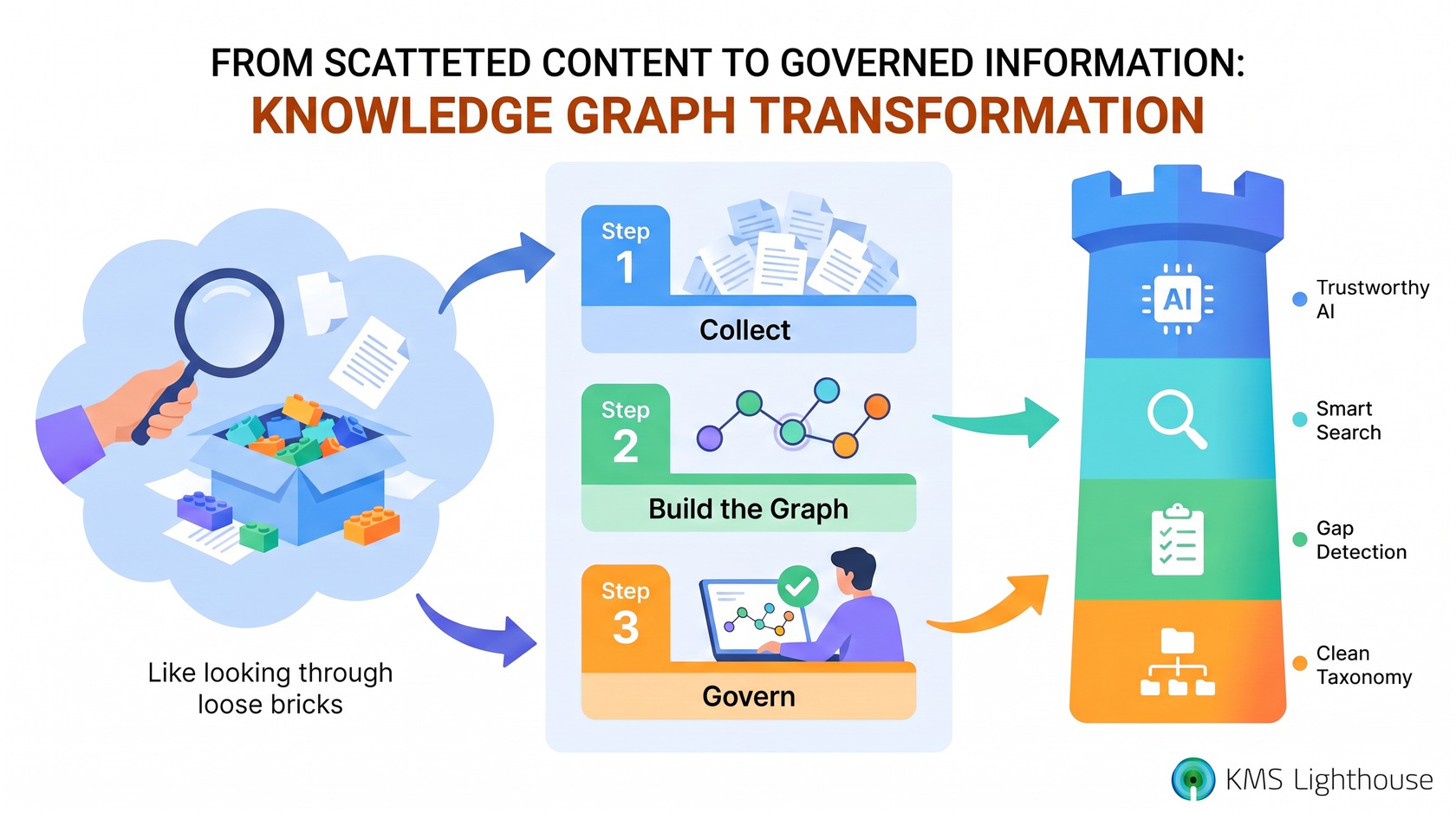
ELI5 Summary: Think of traditional search like looking through a box of loose LEGO bricks, while a knowledge graph shows you the completed castle—it reveals how every single piece connects to the others.
What Is a Knowledge Graph? A Plain-Language Guide
Modern companies often store thousands of documents, articles, policies, and help files. The challenge is not only storing that information, but understanding how the documents, facts, and topics connect to one another.
A pile of documents is not the same as understanding the information inside them. This becomes especially important in AI knowledge management, because AI systems need clear structure and context to connect related pieces of knowledge reliably. Human teams and AI agents both perform better when the facts in a knowledge base are organized in a way that shows how they relate to one another.
A knowledge graph solves this problem by improving knowledge management and access across your organization.
Key Takeaways:
- A knowledge graph connects documents into a map of facts: It gives context to individual data points and allows computers to understand how facts relate to each other.
- Built from three-part facts: Facts are described as a thing, a relationship, and another thing. This allows for cross-document understanding of large stacks of raw information.
- Trustworthy AI power: AI is only as trustworthy as the knowledge powering its responses. A knowledge graph adds to AI’s ability to make reasonable fact-based deductions without guessing or hallucinating.
- Multi-capability solution: One knowledge graph enables better AI answers, more efficient human searches, better gap and link detection, cleaner taxonomy, and content governance.
- Human review is critical: The system finds and suggests connections, while human review and confirmation ensure accuracy.
What Is a Knowledge Graph and What Does It Do?
In simple terms, a knowledge graph is a connected map of information. Instead of treating each document as a separate item, it shows how people, products, policies, issues, and answers relate to one another.
The problem: A list of facts without relationships or context can only get you so far when trying to derive actual knowledge or understanding.
Consider a classic phone book. This is a pure list of facts such as names, addresses, and phone numbers. However, there are no described relationships, and you can only find the information you want by already knowing who or what to search for.
Compare this to a city map. The map contains much of the same information as a phone book, but in a way that adds context to the relationships. You know the topography and distances between things, so you can deduce answers such as “Where is the nearest pizza shop?” without having to go one-by-one through phone book entries.
This is the essence of a knowledge graph. It is a map to the data within your knowledge base, building connective contextual links between individual data points.
This is accomplished through associated relational facts, called “nodes” (the items, such as a person or product) and “edges” (the connecting relationship lines). Each fact in a knowledge graph is made up of two nodes linked by an edge—in other words: one thing + a relationship + another thing.
As a simple example, a single fact in a knowledge graph might look like:
(John Smith) + (designs devices for) + (OEM Inc)
Another fact might look like:
(OEM Inc) + (manufactured) + (Smartphone A)
With these established, a person or AI can reasonably assume a connection between Smartphone A and designer John Smith, even if this connection is not explicitly stated in a single document.
This web of relationships, spread across a sufficiently large knowledge graph, allows for contextual understanding of the big picture, rather than isolated data points.
Why Knowledge Graphs Matter for AI and Search in 2026
As AI knowledge management becomes more commonplace, organizations need ways to ensure AI is put to best use while remaining reliable. AI is only as smart as the knowledge it is based on, so knowledge graphs deliver much better results than simply pointing the AI at a flat list of facts.
Creating a knowledge map for your AI leads to:
| Capability | How the Knowledge Graph Helps |
|---|---|
| 1. Trustworthy AI Answers | Prevents AI helpdesk agents from making guesses or “hallucinating.” A knowledge map allows AI agents to make logical connections between data points. The industry term for AI that follows relationships rather than keyword matching is GraphRAG. |
| 2. Search That Understands Meaning | Improves search for humans and AIs by incorporating contextual meaning. The search automatically follows logical lines of connections to answer complex questions across documents. |
| 3. Finding What’s Missing | Makes it easier to spot missing information gaps in your knowledge base so human moderators and AI can fill them quickly. |
| 4. Discovering Hidden Links | Uncovers unlinked facts and documents across your knowledge base and generates connections automatically to improve contextual search precision. |
| 5. Natural & Consistent Taxonomy | Reveals natural connections between data, helping establish a clean, consistent classification taxonomy that reduces ongoing maintenance burdens. |
How a Knowledge Graph Actually Gets Built
The process behind creating a knowledge graph is straightforward in theory, although the complexity grows alongside the size of your knowledge base. AI knowledge management software assists in the process, but human planning and curation remain essential.
- Render documents into structured meaning: Isolate subjects, relationships, purposes, and outcomes.
- Establish a standardized shared vocabulary: Map paraphrases and synonyms so that “open account,” “start account,” and “set up account” are recognized as equivalent.
- Identify duplicates and contradictions: Recognize overlapping or conflicting documents to edit or remove them.
- Draw connections between documents: Link topics that extend, support, or enhance each other.
- Establish guardrails for human review: Set clear rules identifying which knowledge base updates require human vetting.
Note: Do not fully automate this process. Major changes suggested by AI should always be reviewed and confirmed by human overseers to guarantee long-term accuracy and trust.
Choosing a Knowledge Management Platform Built on a Real Knowledge Graph
Consider these key factors before investing in knowledge management software:
- Content volume and complexity: Highly templated content benefits from graph-based gap detection and comparison. Sparse or bespoke content relies more on structural and demand signals. Choose the tool that fits your current structure.
- AI maturity goals: The more you plan to rely on AI for helpdesks and answer centers, the more critical it is that your KM platform has a real knowledge graph at its core.
- Governance needs: Select a platform with built-in workflows for human review and oversight rather than one that makes autonomous, unverified changes.
- Scale: The value of a knowledge graph grows alongside the volume of your documents. While smaller knowledge bases may not require a graph immediately, transitioning earlier avoids higher migration costs down the road.
Frequently Asked Questions
A knowledge graph maps relationships between pieces of data rather than storing isolated documents. Each fact is made up of three elements: a thing, a relationship, and another thing (e.g., [John Smith] + [works at] + [Company Inc]). These connections allow AI to make logical inferences based on context.
A regular database stores records in fixed tables where you must know what to look for beforehand. A knowledge graph builds an interconnected web of relationships, allowing for flexible discovery and open-ended question answering.
AI is only as reliable as its underlying knowledge. Defined contextual relationships expand the AI’s ability to make accurate, fact-based deductions without making up answers or hallucinating. This approach is known as GraphRAG.
Not necessarily. Knowledge graphs become more valuable as your knowledge base expands. While a small knowledge base can be manually managed, setting up graph foundations early prevents scalability bottlenecks later.
In Conclusion: Knowledge Graphs Enable Reliable AI Knowledge Management
Traditional knowledge bases built from wikis, help articles, and document libraries become difficult to search and maintain as organizations scale. Knowledge graphs make information intuitive to navigate by connecting facts and documents, providing the necessary foundation for reliable AI knowledge management.
KMS Lighthouse makes this happen. Knowledge graphs sit at the heart of our knowledge management platform. Built on a foundation of clean, connected information, KMS Lighthouse powers robust AI agents, accurate gap detection, superior search, and effortless governance.
Contact us today to learn more or request a free demonstration.


