
Key Takeaways
- RAG connects generative AI with current enterprise knowledge instead of forcing a language model to rely entirely on information learned during training.
- The most important RAG benefits include better answer accuracy, faster retrieval, access to current information, and more natural knowledge search.
- A strong RAG system still depends on accurate content, reliable permissions, metadata, and ongoing human governance.
- RAG can make an existing knowledge base considerably more useful by turning stored information into context for direct AI generated answers.
Retrieval augmented generation combines information retrieval with a large language model. Instead of asking the model to answer a question entirely from what it learned during training, the system first searches approved enterprise information for relevant content.
That retrieved information is then supplied to the language model as context. The model uses that context to create a response that reflects your organization’s policies, procedures, products, and other knowledge.
A basic RAG pipeline usually works like this:
- An employee asks a question in natural language
- The system interprets the question and searches relevant knowledge
- The most useful passages are retrieved
- Those passages are provided to the language model
- The model generates an answer grounded in the retrieved information
This architecture is especially useful for rag knowledge management because organizational information changes much faster than a general language model can be retrained.
A well maintained knowledge base in AI gives the retrieval system trusted information to work with. That relationship between governed knowledge and AI is what makes many of the strongest RAG benefits possible.
Why Traditional KMS Search Falls Short at Scale
Traditional knowledge search usually expects the employee to know what to search for.
A user enters several keywords, receives a list of articles, opens the most promising result, scans it for the relevant section, and may repeat the process several times before finding an answer.
That becomes harder as the knowledge base grows.
Employees may encounter:
- Thousands of overlapping articles
- Different terminology for the same issue
- Multiple versions of similar procedures
- Information spread across separate repositories
- Long documents containing only one useful paragraph
- Search results that match words but miss intent
Modern AI adoption makes these limitations more important. A recent Microsoft Azure report found that two thirds of surveyed organizations were implementing RAG or exploring its use, reflecting how important grounding has become as businesses customize generative AI around their own information.
Traditional search still has value, but RAG changes the interaction. Instead of requiring employees to assemble the answer themselves, the system retrieves relevant information and uses it to construct a response.
The 10 RAG Benefits in Knowledge Management
The value of RAG goes beyond making a chatbot sound more intelligent. It changes how employees and AI systems interact with organizational knowledge.
The first five RAG benefits focus primarily on retrieval quality, information freshness, and the employee experience.
1. More Accurate AI Answers
A general language model doesn't automatically know your current procedures, product rules, customer policies, or internal terminology.
RAG provides relevant enterprise content at the moment the question is asked. This gives the model evidence it can use instead of depending entirely on general training knowledge.
Accuracy still depends on retrieval quality and the content itself, but grounding the answer in approved information provides a much stronger foundation.
2. Access to Current Knowledge
Language models are trained at a particular point in time. Your business isn't.
Policies change, products are updated, procedures evolve, and new knowledge is created continuously. RAG can retrieve recently updated information without requiring the underlying language model to be retrained whenever your knowledge changes.
This is especially valuable when an llm knowledge base supports customer service or regulated operations where outdated information can create real consequences.
3. Faster Knowledge Retrieval
Employees often don't need an entire article. They need one answer hidden somewhere inside it.
RAG can retrieve the most relevant passages and present the information through a concise natural language response. That reduces the amount of time employees spend opening documents, scanning pages, and combining information manually.
For large knowledge environments, this can significantly change the employee experience.
4. Better Use of Enterprise Specific Information
Your most valuable business knowledge is rarely part of a public language model's training data.
Internal procedures, service policies, product details, account rules, and institutional expertise may exist only inside your organization's systems.
RAG gives AI a controlled way to retrieve that private enterprise information when it is relevant. Strong enterprise knowledge bases for AI agents provide the governed content those systems need to generate useful answers.
This is one of the most important RAG benefits because it turns a general purpose language model into an assistant that can work with your organization’s actual knowledge.
5. More Natural Employee Search Experiences
Employees shouldn't need to learn the exact terminology used by a knowledge author.
With retrieval augmented generation, users can ask questions conversationally. The retrieval layer can identify information related to the meaning of the question rather than depending entirely on identical wording.
An agent might ask, “What happens if a customer changes states during an active policy?” instead of trying several combinations of policy terminology.
That makes knowledge access feel less like searching a document archive and more like asking an informed colleague for help.
6. Lower Risk of AI Hallucinations
Large language models can produce confident answers that aren't supported by accurate information. RAG reduces that risk by grounding responses in retrieved enterprise content.
A 2025 study published in the Journal of Medical Internet Research found hallucinations in 10% of responses using RAG compared with 38% for native ChatGPT responses in the study.
RAG doesn't eliminate hallucinations completely, but better grounding gives the model stronger evidence to work with.
7. Easier Knowledge Scaling
As organizations grow, the amount of knowledge they manage can increase dramatically. Adding more articles to a traditional knowledge base can eventually make search harder rather than easier.
RAG can retrieve relevant passages from large collections without requiring employees to understand how everything is organized. This allows the knowledge environment to grow while maintaining a more natural search experience.
8. Better Customer Service Consistency
Customer service teams need employees to provide the same accurate information across locations, channels, and shifts.
RAG can ground AI answers in the same approved knowledge used throughout the organization. That helps reduce situations where agents interpret policies differently or depend on personal experience to answer common questions.
These RAG benefits are especially valuable when customer interactions involve complex procedures or rapidly changing information.
9. Stronger Governance and Traceability
A well designed RAG system can show which information contributed to an answer.
That traceability allows employees to review the underlying article or policy when needed. It also gives knowledge managers greater visibility into which content AI systems are using.
Governance becomes even more important when evaluating the broader pros and cons of AI in knowledge management. AI can improve access to information, but organizations still need ownership, permissions, review processes, and quality controls.
10. More Useful AI Agents
RAG becomes even more powerful when AI assistants need to handle complicated questions.
Advanced systems can break a question into smaller parts, conduct several searches, evaluate the retrieved information, and search again when the evidence isn't sufficient. This approach is often called Agentic RAG.
Instead of automatically answering every question, a better knowledge assistant can recognize uncertainty and ask for clarification when necessary.
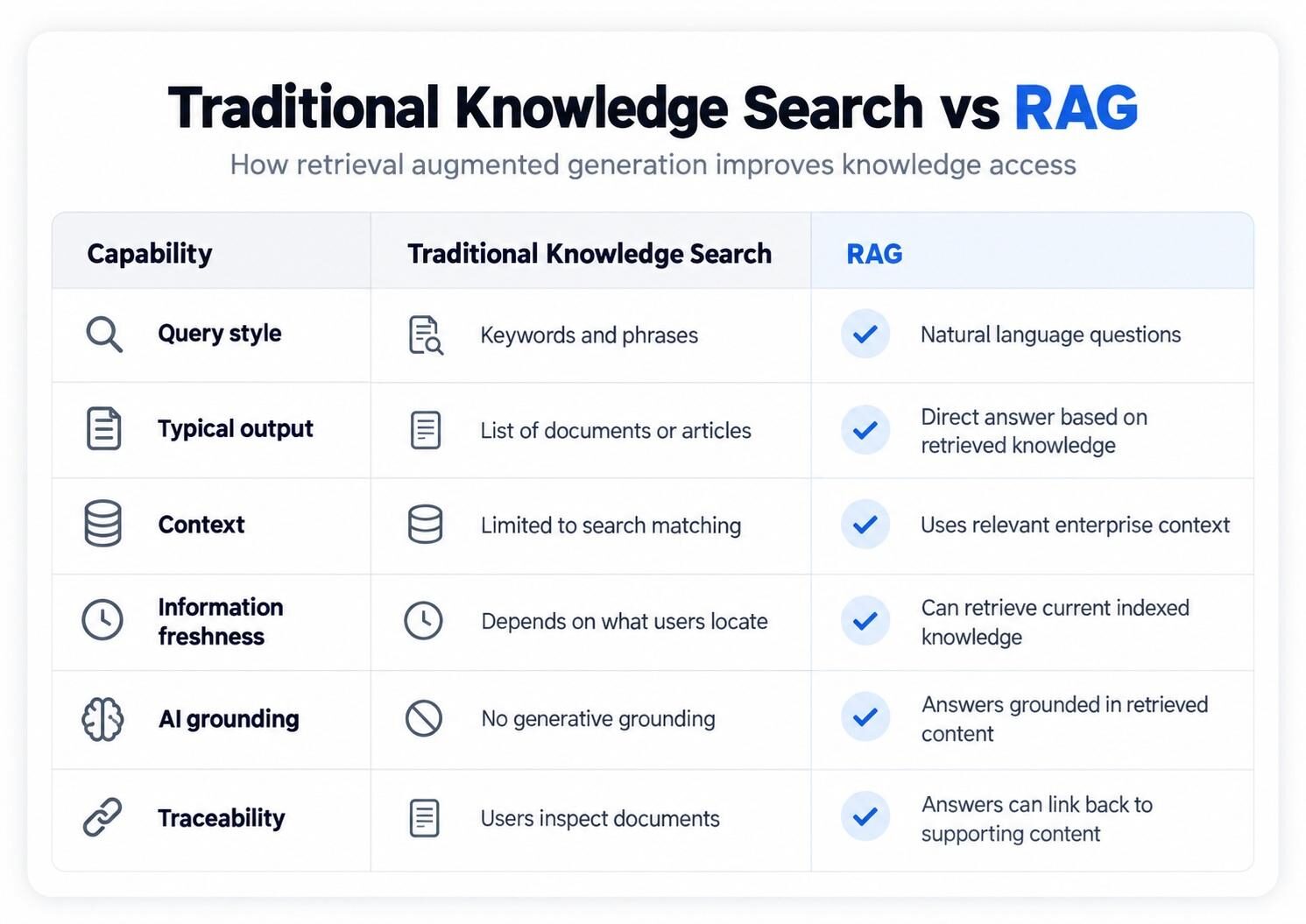
The goal isn't necessarily to eliminate traditional search. Instead, RAG adds an intelligent retrieval and answer layer that can make existing enterprise knowledge easier to use.
What RAG Cannot Do and Where Human Curation Still Matters
RAG can retrieve information, but it can't automatically make bad information trustworthy.
If the knowledge base contains outdated procedures, conflicting policies, duplicate content, or incorrect articles, the system may retrieve those problems faster.
Human knowledge managers and subject matter experts still need to:
- Approve important content
- Remove outdated information
- Resolve conflicting procedures
- Maintain permissions
- Review AI performance
- Identify missing knowledge
Strong governance remains one of the most important requirements for getting consistent RAG benefits over time.
How to Start Implementing RAG in Your Knowledge Management Stack
Begin with the knowledge itself rather than the AI model.
A practical implementation process should include:
- Audit your existing knowledge
- Remove outdated and duplicate content
- Identify authoritative information
- Establish permissions and ownership
- Connect the retrieval system to approved repositories
- Test using real employee questions
- Measure answer accuracy and retrieval quality
- Improve weak content and failed searches
A useful guide to building an AI powered knowledge base starts with cleaning and organizing information before relying on AI to retrieve it.
Start with one focused department or use case. Once retrieval quality and employee adoption are strong, expand the system gradually.
FAQ
Fine tuning changes a model's behavior by training it on additional examples. RAG retrieves external information when a question is asked and provides that information as context. RAG is generally better suited to knowledge that changes frequently because content can be updated without retraining the underlying model.
RAG can connect with many existing knowledge repositories, but results depend heavily on content quality, structure, permissions, and available integrations. Knowledge that is outdated, duplicated, poorly organized, or inaccessible can weaken retrieval accuracy even when the AI model itself performs well.
There isn't one standard cost. Expenses vary based on knowledge volume, existing infrastructure, integrations, AI models, retrieval technology, security requirements, and implementation complexity. Organizations should also account for content cleanup, testing, governance, monitoring, and ongoing AI usage rather than evaluating software licensing alone.
RAG works best with accurate, current, clearly organized, and properly governed information. Metadata and consistent terminology can also improve retrieval. The system should know which information is authoritative so outdated or conflicting documents don't compete with current procedures when generating answers.
Yes. RAG can reduce hallucinations by giving the language model relevant information to use when creating an answer. However, it doesn't guarantee accuracy. Poor retrieval, missing information, contradictory content, or model errors can still produce incorrect responses, which is why evaluation and human oversight remain important.
Build Better AI Answers on Better Enterprise Knowledge
The strongest RAG benefits come from combining intelligent retrieval with accurate, governed enterprise knowledge. Better technology improves access, but reliable content is what gives AI answers their value.
Contact us today to learn how KMS Lighthouse can help you turn trusted enterprise knowledge into faster, more accurate AI powered answers.