
Rotem Ram
Product Manager, KMS Lighthouse
Enterprise knowledge management is only as strong as the quality of the information it is built on. In today’s organizations, knowledge bases are growing rapidly in size, complexity, and usage. As a result, maintaining consistency, accuracy, and relevance has become increasingly difficult.
Without a continuous quality framework, enterprise knowledge quickly becomes fragmented, containing outdated procedures, inconsistent guidance, and duplicated or conflicting content. In such an environment, even the most advanced systems struggle to deliver reliable value.
In the era of Generative AI (GenAI), this challenge becomes even more critical. AI systems do not inherently validate knowledge, they rely entirely on the data they are grounded on. If the underlying information is inaccurate or inconsistent, the outputs will reflect the same issues, at scale and with speed.
This is why organizations can no longer treat knowledge quality as a secondary concern. It must become a continuous, measurable discipline.
Today, one of the most effective ways to ensure and continuously improve knowledge quality is through KMS Lighthouse’s Article Score capability.
This article explains what Article Score is, why it matters in modern enterprise knowledge management, how it is measured, and how organizations can improve knowledge quality at scale.
Why Knowledge Quality Matters
Internal knowledge powers every part of your organization. Employees, contact center agents, and AI systems all rely on the same foundation of trusted information.
When that knowledge is inaccurate, outdated, or inconsistent, the impact is felt across the entire organization:
- SOPs may not be followed correctly
- Regulatory requirements may be missed
- Customer support may provide incorrect answers
- Teams may operate with conflicting procedures
- AI chatbots become unreliable
- New employees struggle to get up to speed
The result is operational inefficiency, increased risk of compliance issues, and poor customer experience. All of which ultimately affect business performance and profitability.
On the other hand, high-quality knowledge improves alignment, efficiency, and customer experience across the organization.
What Is Article Score?
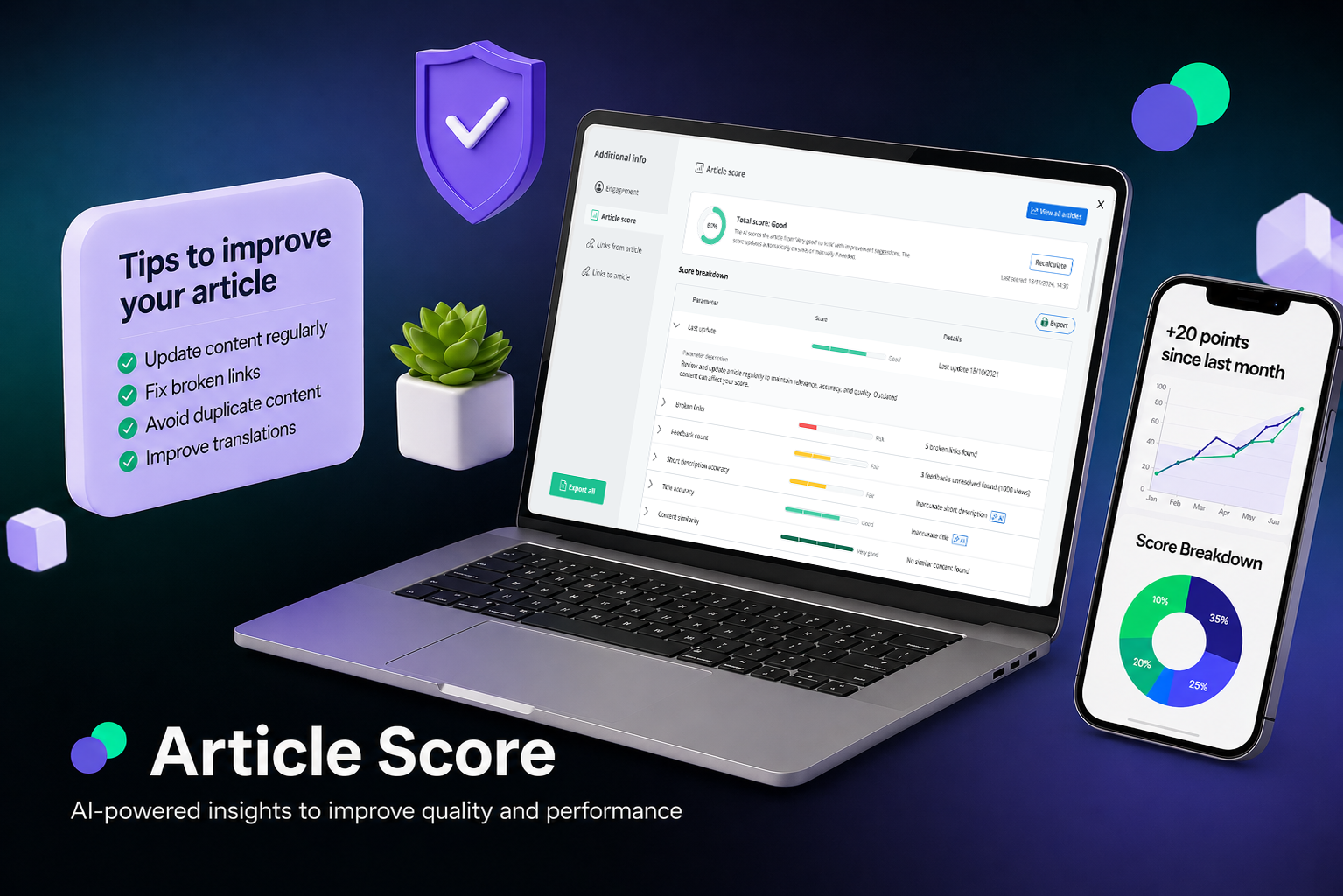
Simply put, Article Score is a quality metric that evaluates the effectiveness of knowledge articles and institutional content.
It provides content managers with a standardized, data-driven way to assess content quality, identify gaps, and prioritize improvements without relying solely on manual review.
Article Score combines structured content quality parameters with AI-driven analysis to deliver a structured evaluation of each article.
What Does Article Score Measure?
Article Score evaluates content across multiple dimensions, including:
- Content freshness
- Broken links and technical integrity
- Feedback count
- Title and short description accuracy
- Content similarity and duplication
- Contradictions across knowledge articles
- Tone, clarity, and readability
Together, these parameters provide a holistic view of content quality across accuracy, usability, consistency, and reliability.
AI-based analysis provides an additional layer of evaluation, enabling the identification of content issues that require attention and enhancing relevance within knowledge base search results.
Why Traditional Metrics Are No Longer Enough
Traditional knowledge quality metrics are limited:
- Page views do not necessarily reflect usefulness; they mainly indicate search visibility
- User feedback on usefulness is often biased, as users rarely take the time to mark content as helpful
- Manual reviews do not scale and become increasingly impractical as knowledge bases grow
- Static audits lack real-world usage signals and fail to reflect ongoing content behavior
As knowledge bases grow, these methods fail to provide continuous insight into content health. Article Score addresses this by enabling ongoing, automated quality evaluation at scale.
How Article Score Improves Knowledge Management
A well-implemented Article Score system enables organizations to:
- Quickly identify high-quality content and content that requires attention
- Prioritize updates based on article scores, allowing teams to focus on lower-scoring or outdated content, and clearly understand what needs improvement and where effort should be invested
- Maintain consistency in fast-changing environments
- Focus on high-value content areas
- Gain better visibility into knowledge health and make more informed decisions based on it
In short, Article Score makes knowledge management more efficient, scalable, data-driven, and easier to maintain for knowledge management teams.
Business Impact
Once an Article Score-based system is implemented, it can significantly improve both business performance and day-to-day operations. Key benefits include:
- Faster employee onboarding supported by reliable and relevant knowledge
- Fewer operational mistakes and reduced costly rework
- Lower risk of regulatory violations and associated penalties
- More consistent customer experiences across support channels and self-service tools
- Increased trust in answers provided by AI-powered systems
- More accurate and relevant search results across the knowledge base
- Stronger knowledge base and improved internal compliance
- Better, data-driven managerial decision-making based on trusted information
When integrated into a broader knowledge management strategy, Article Score helps streamline operations, improve efficiency, and reduce costs across multiple areas of the organization.
Article Score in an AI-Driven Knowledge Strategy
AI is becoming a core component of modern knowledge management strategies. However, as knowledge bases grow in scale and complexity, fully manual management is no longer practical. By the time a review cycle is completed, previously approved information may already be outdated.
Modern knowledge management must therefore support both human users and AI-driven systems, while enabling real-time, data-informed decision-making.
Article Score ensures that AI systems operate on verified, consistent, and high-quality knowledge, while continuous monitoring and analysis of knowledge quality are performed automatically. This combination creates a continuous feedback loop that constantly improves the accuracy, consistency, and relevance of the entire enterprise knowledge ecosystem.
Conclusion: Deploy Article Score for Better Knowledge Management
Article Score is a foundational capability for modern enterprise knowledge management. By making knowledge quality measurable, actionable, and continuously improvable, it enables organizations to maintain trusted knowledge at scale for employees, customers, and AI systems alike.
At KMS Lighthouse, we help organizations transition to AI-powered knowledge management with solutions designed to reduce errors, lower support costs, and improve customer experience.
Contact us to learn more, or schedule a free demonstration.


